


In part one, I wrote about how the Bitcoin Network's power consumption doesn't scale the way most people think it does. As well, even as the network scales up, it won't use as much power as people are worried about.
In this article, I want to expand that idea by saying that "even if the network does grow much bigger, the electrical impact on the planet will be zero". How is that possible? By miners chasing the lowest priced power possible, which leads them to making the entire electrical grid more efficient.
Behind the electrical grid, there is a huge trading market for power. All the power plants, electrical companies, and large power consumers are constantly trading for who can provide the best power, and who needs it where. People aren't necessarily buying power because of its price, large power consumers buy the most reliable power. It doesn't matter if you have cheap power if you risk a brownout or blackout. Reliability is more important than getting a good deal. The one exception to this rule is Bitcoin and Crypto-currency miners. To them, reliability is less important, and getting a good deal is top priority.
I'll provide some backstory first by telling the basics of how we use electricity in the world. First, the demand for power is estimated based on usage patterns and historical levels. Second, power is generated at one of the many power stations. Third, it travels along power lines and other infrastructure towards our cities. Fourth, once the power reaches its destination it is transformed down to the required level. Finally, people consume the power to do work. All of these steps require work and costs that are reflected in the final cost of power to the consumer. Let's break these steps down further.
First, power is generated at power stations on an "as needed" basis. This need is estimated based on historical data, and on how much power is being consumed in the area. Sometimes extra power is generated to be sold in a different area, based on the demands of the power market. Regardless, power producers are trying to produce as much power as they can to sell, but they don't want to produce too much, because if there is no buyer they are forced to burn off the extra power. There is no good way to store large scale power, which is one of the reasons why the large scale battery solutions Tesla is making is so important.
Second, when power is created, it must be put into the network and used, otherwise it must be burned away. This is one of the big difficulties with renewable's because they cannot be turned on and off to match demand. Solar works when the sun shines, wind works when the wind blows, there is nothing that can be done to change that. The best renewable for this is hydro dams because when power is needed they can open the floodgates, and when there is excess power they can pump water back up into the reservoir. Fossil fuels have a big advantage here because when power is needed more coal can be burned, and when power is not needed it is easy to store the coal for a later date. Nuclear can be turned "on and off" as well. This "on and off" cycle isn't instant, it takes time for a power plant to fire up and begin producing power, as well as cool down to stop. It's better for a power plant to produce a constant flow of power, instead of taking the time and effort to turn on and off to match demand. This is the other reason why the price isn't the most important thing in the power market, sometimes a producer is willing to sell power for less than market price because they want to keep the plant working for longer instead of turning off. Since power is created on-demand, and the demand fluctuates, it is common that too much power is made and must be burnt away. This is an expense to the power plant, they are forced to burn off their product and can't make money. To make up for this, the power that is sold must be sold at a slightly higher price to offset this loss.
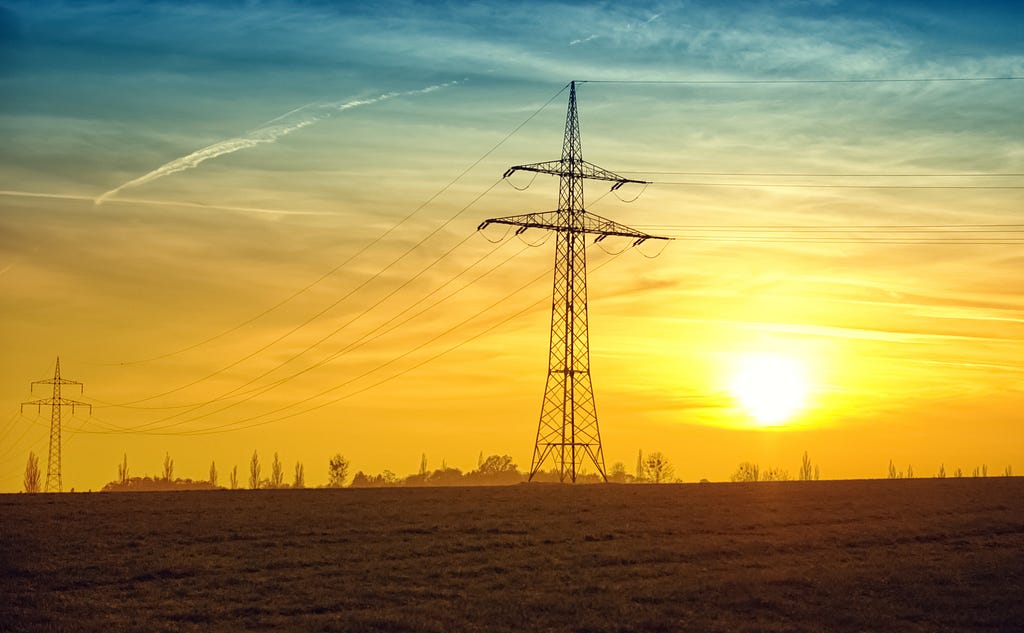
Third, the power needs to be transformed for transport. Depending on how the power plant is set up, different types of power are generated. Whatever is made needs to be transformed into high voltage AC (up to and above 300 000 volts) to be sent down the power lines. This requires a high power electrical infrastructure, which doesn't come cheap. Once it is at the correct level, the power is sent down the transmission lines. Someone has to build and maintain the power lines, which comes at a cost, which increases the final cost of power. The reason such high voltage power is used is that power is more efficiently transported at higher voltages. For example, if you want to transport a megawatt (1 million watts) of power, you could either transport it at any range from 10V and 100 000A, 1000V and 1000A, or 100 000V and 10A. If you have high amperage, you need huge thick wires to safely carry it. Above 100A, it begins to look less like wires, and more like bars of metal. Having to create power lines that hold that much weight is inefficient. On top of that, moving higher amperage down wires generates extra heat. Extra heat is wasted energy. Using high voltage instead of high amperage means that you can have smaller power lines, and lose less energy to heat.
Fourth, the power must be transformed again at the city level. There are large substations within each city that transforms the high power down into lower power to be moved around the city. It is dangerous to have power lines with hundreds of thousands of volts in the city, so it is transformed down to 10 000-15 000 volts. Beyond that, it is transformed further to household levels, which is 120-220V depending where you are in the world. These power transformations are done as close to the source as possible because keeping the voltage higher while it travels is more efficient. There are substations in each city to lower the voltage, power transformers on the street, and transformers on the power lines beside the houses. In industrial and commercial areas, the power is transformed to different levels for the needs of the different building. All these transformations are to keep power as high as possible for maximum efficiency, but also as low as it can go for safety. But, all these transformations come at a cost of infrastructure and maintenance.
Finally, power is consumed by the consumer. Based on all the costs in the previous steps, the electric company then puts a markup on cost to be sold to the consumer. Where I live, we have BC Hydro that controls the power rates. Depending on how much you use and when you use it there is a sliding scale for what it will cost.
Here's a quick list of the power cycle:
- Power is generated at the plant
- Power is transformed for transport
- Power is transported
- Power is transformed back down for use
- Power is sold to the customer via electrical companies.
With that all out of the way, how do crypto miners find the best deals on power? They move as close to the source, #1, as possible. On one hand, they move their mining operations around the world to find the countries/cities with the cheapest power. Once they have a good location, they build a mine as close as possible to the power plant to minimize transportation and infrastructure costs. Different sized mines have more flexibility with moving and building new buildings to host their mines, so there are sacrifices made at every level to keep different sized mining operations realistic. Even once they're as close as possible to the source, its more economical to keep the transformation costs in house, instead of outsourcing. This is one of the reasons industrial power is usually cheaper than residential power. The electric company can give a high power line directly to an industrial building, and the building can use that high power for the machines. The electric company doesn't have to deal with the cost of street level and power pole level transformers, so they can sell power cheaper.
The final cost to cut is the middle man. By buying power directly from the power plant, instead of dealing with the electric company, miners can get an even smaller cost. Compare these 2 scenarios:
- A mine is hosted in a regular commercial building in a city. It uses basic commercial rates, using the cities infrastructure to transport and transform the power, and pays an electric company for reliable electricity.
- A mine moves its operation to beside a power plant. It provides all its own infrastructure for transporting and transforming power. The mine buys power directly from the power plant, instead of the electric company.
Scenario 2 provides huge cost savings over time. Its a larger startup cost, but once the operation is running the costs are far lower. This allows miners to run their machines longer, with a larger profit margin.
After all this cost analysis, there is a final piece to the puzzle, which is the main premise of this article. By sacrificing reliable power, a mine can cut its costs even further, and reduce waste electricity for the entire grid.
When you look at power on a global scale, there are 2 terms to be familiar with. Total Primary Energy Supply (TPES) is the amount of power that all power plants produced in the year. It is the total amount of power the world has generated. World Energy Consumption (WEC) is the amount of power that the planet actually used. The discrepancy between these 2 numbers shows the inefficiencies in the entire grid, as well as the cost that is paid for reliability.
If you look at the primary energy supply and world energy consumption, the difference ranges from 30-50% over the years1. That's insane, it means that sometimes 50% of the power that is generated is wasted. Seeing as the entire bitcoin network uses less than 1% of the world energy consumption, it seems a drop in the bucket compared to wasting 50%.
To be fair, there is an argument to be made that there has to be waste. If reliability is the most important thing (and it should be), excess power will always need to be generated in order to account for fluctuations. However, Bitcoin can help save the day here as well to get the best of both worlds. Reliable power, with minimal waste.
As we talked about power plants above, it's hard for a power plant to turn on and off. Once its generating power, it wants to keep generating, and once it's turned off, it doesn't want to turn back on unless there's a good reason. Most other things in life are like this as well. When there's a blackout in a city, everyone is affected. Critical services have to have backup power sources (like hospitals) to ensure that everyone is kept safe and has power. Even in other data centers, power reliability is one of the most important factors. One of the biggest differences between a good data center and a bad data center (tier one to tier four)is how reliable it is on both the power and networking side2. Bitcoin is different from all of that.
A well-designed bitcoin miner, and by extension a bitcoin mine, can be unplugged at any time. As soon as you plug it back in, it fires back up and gets back to work. Worst case scenario, a miner is working towards a block, the power is cut, it loses that work, and has to wait 10 min to participate in the next block. Scaling this to a mine level, you can cut the power, the mine shuts down, re-enable power, and the mine will boot back up within minutes. The thing that takes longest to reconnect after a power loss is an internet router, and that is a tiny power cost that is easily put on backup.
What this means is that unlike everything else in the world, a bitcoin mine can be unplugged at any time with no ill consequences. This allows it to remove the final barrier to cheap power, reliability. A bitcoin mine can exist beside a power plant and use all the excess power from that plant. The power plant has a constant load that it can sell power to, but at the same time, it has the freedom to turn that load off if the grid has a surge and demands extra power. This allows a bitcoin mine to buy power from power plants that would otherwise be wasted. Instead of a power plant turning on and off to account for surges in the grid, it can stay on and direct power either to the grid or the mine.
By doing so, this leads to less power wasted for the world, and cheap power for the Bitcoin miners. In theory, this concept could be applied to other data centers as well. Not the data centers that power websites and cloud storage, those need almost 100% uptime and reliability. But there are cloud solutions for processing tasks, such as video rendering or AI training, that could be interrupted. Assuming the computers were designed to automatically pick up where they left off, and there were often enough backups, a computer rendering a video could get shut off in the middle of work and then turn back on to pick up where it left off.
In conclusion, by trying to maximize their profit margins, cryptocurrency miners have discovered a way to improve the electrical efficiency for the entire planet. By moving their operations as close as possible to power plants, and buying directly from the source, cryptocurrency miners can use the excess generated power to do work and reduce the global electrical waste.